

How do you stage extinction?
More and more theatre is tackling the climate crisis. But can it really grapple with the vast concept of extinction, wonders Catherine Love

By Catherine Love
A dancer stands alone on stage, quivering in the light. Through the speakers comes the disembodied voice of a young girl watching a bird. “Has she gone away forever?” the voice asks. The dancer’s head darts back and forth, her neck and arms twitching and fluttering. In this first part of dance-theatre trilogy Figures in Extinction, the dancer has become both the girl observing the bird and the bird itself.
And yet, at the same time, she’s neither. The projected text above her tells us this is the Bachman’s warbler – extinct since the mid-20th century. Gone away. Forever.
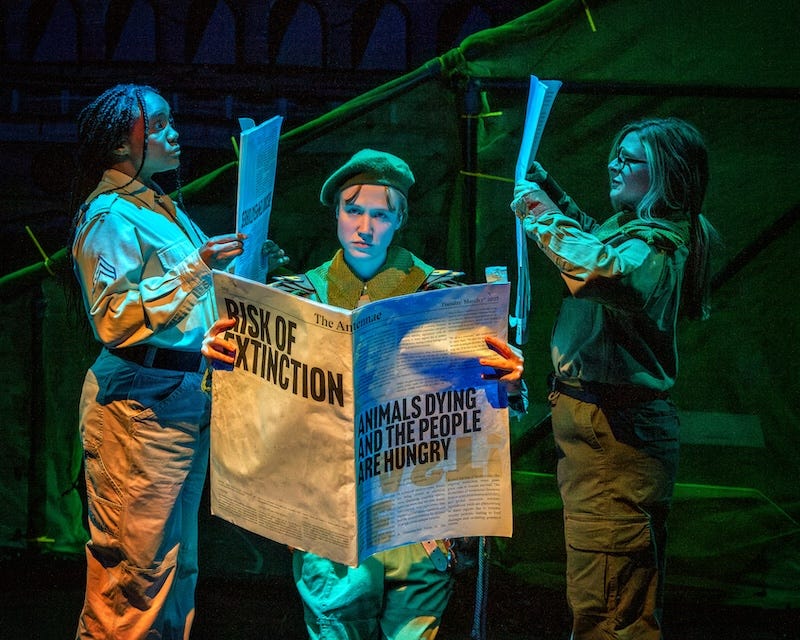
Another day, on another stage, a performer in military-style costume delivers a speech. Bric à Brac Theatre and Told by an Idiot’s new show The Intrusion stages a crisis situation: the world as we know it has been wiped out and those who remain need to make sacrifices for the greater good. The leader in front of us talks about emergency measures and what must be done for the cause. It’s the kind of speech we’ve all heard before.
The twist?
**Spoiler alert**
Both the leader and her followers are cockroaches — the indestructible inheritors of the earth. Non-humans in a distinctly human guise.
These two snapshots from my recent theatregoing take me back to an old familiar problem: how do you stage something as vast, as complex, as unthinkable as the climate and ecological crisis? It’s a question I’ve been turning over for a long time in my parallel lives as theatre critic, academic, and environmental activist. I believe — of course I would — that theatre has something to say in this present moment, defined as it is by extreme weather, global instability and mass extinction. But just what theatre is able to say, and how, is a lot harder to answer.
I keep coming back to a term coined by philosopher Timothy Morton that I think captures the mushy complexity of what we’re dealing with and why it’s so hard to respond to artistically. Morton describes climate change as a ‘hyperobject’: a phenomenon that’s too huge to grasp in its entirety and can only be glimpsed in fragments. The crisis that we find ourselves in is one of epic timescales and massive structural forces that escape our puny human understanding. How could anyone be expected to condense all that on stage?
And yet more and more artists are trying to grapple with these complicated realities. A decade ago I was moaning about the relative lack of climate drama and often cringing at the few examples I did see, which tended to either impart dry facts or bludgeon audiences with heavy-handed metaphors. Now eco-theatre is everywhere. As I identified at the Edinburgh Fringe in 2019, a new wave of climate shows seemed to be powered by the surge in environmental activism at the end of the last decade, and that momentum has continued. Whether as backdrop or central focus, I keep seeing the climate and ecological crisis on stages and in the programme announcements of theatres. There are performance lectures on impending apocalypse, bikes generating power on stage, dramas about climate change treaties and environmental protest movements, energy-harvesting dancefloors. In a reflection of the growing urgency of environmental issues, theatre-makers are increasingly looking for ways to depict them.
One of the big challenges posed by the climate and ecological crisis is that it’s both a human and a more-than-human problem. Humans are the makers of this mess (though, it’s worth adding, some humans much more so than others), yet it’s our sense of detachment from the non-human world that’s part of the problem. If we continue to think of ourselves as exceptional rather than interconnected, above what we call ‘nature’ rather than enmeshed within it, then we’ll keep making the same mistakes. But theatre is a very human art form, accustomed to showing us people talking amongst themselves, usually in controlled indoor environments. And art itself is one of the things that we humans commonly think of as separating us from other animals. So, what to do?
